Joi - Live Video Chat
- 4.4
- Rating
- 10.00M
- Installs
- Free
- Price

 Analysis by App-foxy
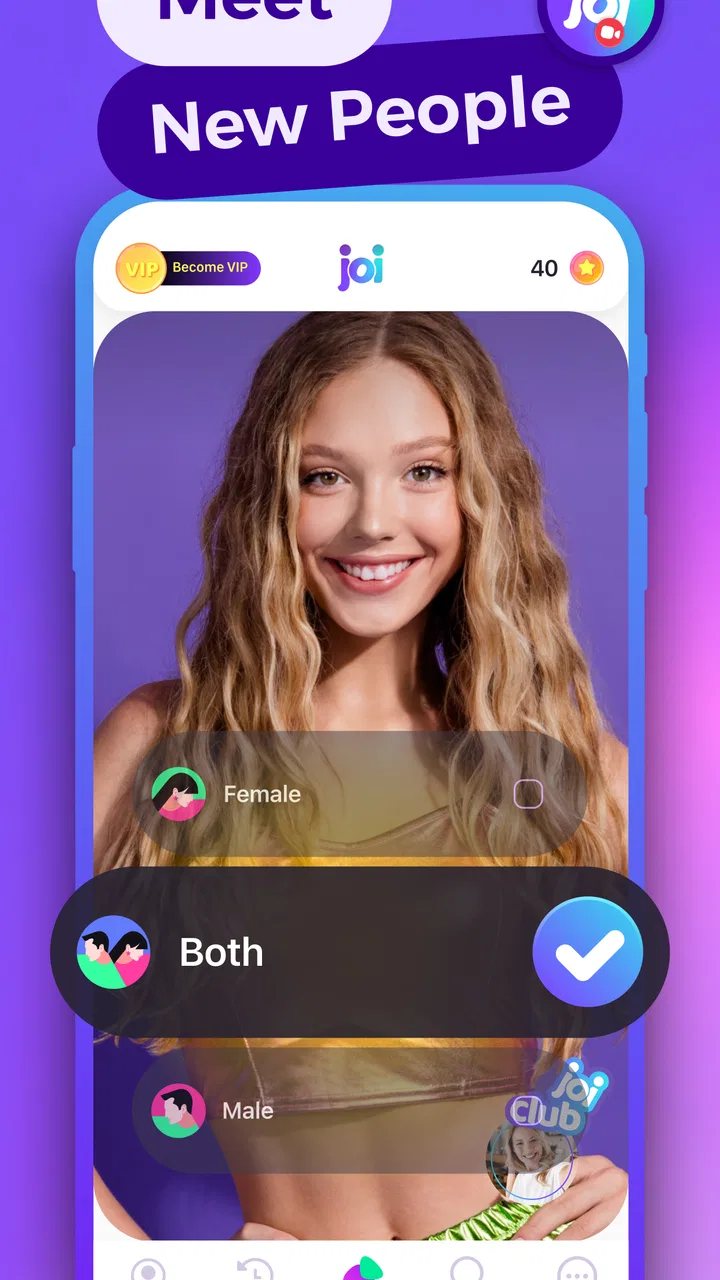
I approached Joi - Live Video Chat as a social app for people who want conversation to begin immediately rather than through a carefully built profile. Its main appeal is the chance to meet unfamiliar people through live video and random calls, which gives it a very different rhythm from ordinary messaging networks. You do not spend most of your time arranging a polished feed or waiting for a mutual connection; the point is the encounter itself.
That immediacy is also the reason I would not recommend it casually to everyone. Video puts your face, voice, surroundings, and reactions in front of another person, so the experience demands more awareness than text chat. In my view, Joi is best understood as an adult-oriented social discovery app: useful when you want spontaneous interaction, less suitable when you want predictable contacts, a quiet community, or a carefully controlled way to make friends.
How Joi feels in its current form
Joi is a free social app from VLMedia A.Ş. It is available for Android devices running at least Android 6.0, and its current version is 2.7.0.2. The app has reached over 10 million installs and holds an average rating of 4.4 from around 92 thousand ratings, with roughly 4.6 thousand written reviews. Those figures suggest that it has found a substantial audience, although popularity alone does not remove the need to use good judgment during live conversations.
You May Also Like

 Blood Strike: 2.5 Anniversary
Blood Strike’s Loadouts Turn Every Drop Into a Tactical Gamble
A close look at Blood Strike’s custom loadouts: how fast access to signature weapons reshapes its battle royale rhythm, rewards preparation, and narrows the gap between fights.

 Pandora - Music & Podcasts
Pandora’s Music Is Easy to Start, but Harder to Recover
Pandora’s strength is its low-effort path from a seed to a station. Its weak spot is how much confidence it asks you to place in connection, setup, and quiet recovery.

 8 Ball Pool
 Is Built on Rivalries, Rematches, and Routine
A close look at the rivalries, rematches, shared routines, and unanswered safety questions that turn a quick pool match into a persistent mobile community.

 Samsung Music
’s Quiet Strength Is Playing What You Already Own
Its reach comes less from spectacle than from dependable access to a personal library. That simplicity is both the app’s strongest retention engine and its ceiling.

 AccuWeather: Weather Radar
AccuWeather Review: A Quick, Clear Forecast for Everyday Decisions
For everyday plans, the best forecast is the one you can understand quickly. AccuWeather makes rain timing, radar, and local conditions easy to act on, with a few trade-offs.

 Hill Climb Racing
Why Hill Climb Racing Still Turns Crashes Into One More Run
A tiny car, a bumpy hill and one more upgrade: Hill Climb Racing keeps resurfacing because its simple chaos makes every near-miss feel personal.
More From Our News Desk
View All News


The store presents it for mature users aged 17 and over. That age guidance matters because random video chat can expose you to conversations and behavior that are not appropriate for younger users. I would treat the rating as a minimum boundary, not as a promise that every interaction will feel comfortable or well moderated. Anyone who is easily pressured by strangers, uncomfortable appearing on camera, or looking for a child-friendly environment should skip it.
The first thing I noticed about this kind of service is how quickly it changes the social mood. Traditional social networks reward preparation: you choose a photo, write a description, follow people, and gradually decide what to share. Joi is more immediate. A person can move from curiosity to a live conversation in a short time, which makes the app feel lively but also makes each decision more important.
I found the strongest use case to be a short, low-commitment conversation when I did not want to maintain another social profile. It can fill an idle moment, offer contact with people outside my usual circle, and create a sense of novelty that ordinary messaging apps rarely provide. The trade-off is that novelty is not the same as compatibility. Some calls will be pleasant, some will be awkward, and some will end almost as soon as they begin.
What the current experience is good at
The live format removes a common problem in online social apps: long stretches of silent messaging. If you are tired of writing opening lines or waiting for someone to answer, random video calls offer a more direct route to interaction. A real voice and facial expression can make a conversation feel more human than a sequence of short text replies.
There is also a useful psychological advantage for people who want to practice casual conversation. Because the encounters are brief and unpredictable, Joi can help you become more comfortable starting a discussion, asking a simple question, or ending a call politely. I would not describe that as formal language learning or therapy, but it can be a practical setting for low-stakes social practice if you keep your expectations realistic.
Another strength is the lack of pressure to turn every interaction into a permanent connection. On many social platforms, the goal is to collect followers or build a visible identity. Here, a conversation can simply be a conversation. That makes the app appealing to someone who wants spontaneous contact without committing to a long-running chat history or public timeline.
Where the format creates friction
Random video is inherently less predictable than text. A stranger may not share your interests, communication style, language, or sense of boundaries. Even a harmless mismatch can make a call uncomfortable because you have fewer moments to think before responding. I recommend deciding in advance what you will not discuss and ending the call as soon as the interaction crosses that line.
Privacy requires more than avoiding your full name. Background details, workplace objects, school materials, neighborhood views, and notifications can reveal information unintentionally. Before using the camera, I would choose a neutral setting, remove visible personal documents, and check what appears behind me. A headset can also help keep nearby conversations from becoming part of the call.
The free entry point is useful, but the app includes in-app purchases ranging from fifty cents to $189.99 per item. That is a wide spread, so I would never tap a purchase option without checking exactly what it offers and whether it is a one-time item or part of a broader spending pattern. The best way to use Joi is to treat paid features as optional rather than necessary for deciding whether the basic experience suits you.
What the version history means for existing users
The current version, 2.7.0.2, is the clearest marker of the app’s present state. For someone who already uses Joi, staying on the current release is sensible because live communication depends on the app working reliably with the device and service around it. I would update before judging the experience after a long break, since an older installation may not represent how the app feels now.
There is an important distinction between a confirmed version number and a promise about the future. The version tells me where the product currently stands, but it does not justify assuming that every desired feature, moderation improvement, or performance change is already present. I would judge Joi by what I can actually use in the current build rather than by expectations created by a future roadmap.
For existing users, the practical effect of a newer build is less about learning an entirely different social network and more about adapting to the current flow of live interaction. If you return after time away, revisit your privacy habits, spending controls, and comfort limits instead of assuming that your old routine is still ideal. A familiar app can still produce unfamiliar conversations.
I also recommend testing the experience in a calm setting rather than forming an opinion during a rushed commute or a noisy room. Video calls are sensitive to distractions on both sides. A poor first impression may come from the situation rather than the app, while a pleasant call should not tempt you to overlook warning signs simply because the conversation feels exciting.
How Joi compares with familiar alternatives
Compared with messaging apps, Joi is faster at creating a live encounter but weaker for carefully choosing who you contact. Messaging gives you time to inspect a profile, compose a response, and decide whether to continue. Joi places more weight on immediate chemistry and your ability to manage an unexpected conversation.
Compared with large social networks, it is less centered on a public identity and ongoing content. You are not using it primarily to follow news, share a polished life update, or maintain a broad audience. That makes it more focused for spontaneous conversation, but it also means you should not expect the same sense of continuity that comes from a familiar feed and established contacts.
Compared with dating-oriented services, Joi’s random-call approach can feel less structured. Dating apps normally encourage filtering, matching, and gradual discovery, while Joi emphasizes the live moment. If your goal is a serious relationship, detailed compatibility, or a slow progression from profile to conversation, a more deliberate dating service may be a better fit. If your goal is simply to talk to someone new without building a formal match, Joi has a clearer advantage.
Small habits that make a large difference
My first practical tip is to use a two-stage approach: begin with a short conversation, then decide whether the person has earned more of your attention. Do not share contact details, social handles, workplace information, or travel plans just because the first few minutes feel friendly. Live video can create fast familiarity, but familiarity is not the same as trust.
Second, prepare a simple exit phrase before you start. Something as ordinary as saying that you need to go prevents you from staying in a call because you are searching for a polite ending. This is especially useful when a stranger becomes pushy. The ability to leave quickly is one of the most important controls in a random video environment.
Third, separate entertainment from emotional dependence. Joi can make a quiet evening feel more social, but random conversations are inconsistent by nature. If you are using it because you feel lonely, set a time limit and avoid measuring your mood by whether the next call is warm or dismissive. The app works better as one social option than as your only source of connection.
A fourth useful habit is to review purchases with the same care you would use in any free app that offers optional items. Decide beforehand whether you are willing to spend anything, and keep the choice deliberate. The presence of a free download does not mean every part of the experience has to remain free, so understanding your own limit is more reliable than making an impulse decision during an engaging session.
Who should try it, and who should pass
I would recommend Joi to adults who enjoy spontaneous conversation, can tolerate unpredictable social encounters, and are comfortable appearing on camera. It is particularly suited to someone who wants a quick change from ordinary messaging, enjoys meeting people outside a familiar circle, or wants informal practice with starting conversations.
I would advise against it for anyone seeking strong control over who appears, a guaranteed respectful interaction, or a structured path toward a specific relationship. It is also a poor choice for users who dislike video, have limited privacy at home, or may find it difficult to stop a conversation when boundaries are ignored. In those cases, text-first communities or carefully matched services offer more control.
Parents should not treat the mature rating as a substitute for supervision or family rules. The app’s format is built around contact with strangers, and that is precisely why younger users should not be experimenting with it. For adults, the same principle applies in a different form: age does not remove the need for caution, consent, and restraint.
What I would watch before committing to it
The most important things to watch are the quality of the conversations, the ease of ending unwanted calls, and whether the overall experience feels worth the attention it demands. A live social app succeeds only when the user can find enough enjoyable interactions without feeling trapped by poor ones. I would also pay attention to how clearly optional purchases are presented and whether the free experience remains useful without spending.
I would not make a decision based only on the 4.4 average rating or the large install count. Those figures show broad interest, but they cannot predict whether your preferred conversation style will match the people you meet. The better test is a short session with firm privacy boundaries and no purchase pressure. If the format feels natural, Joi may become a handy occasional social outlet; if every call feels like work, its popularity will not change that.
After using it, my view is positive but deliberately cautious. Joi offers something that standard social platforms do not: immediate, face-to-face contact with strangers and no requirement to build a public online life first. That is a genuine strength. At the same time, the same randomness that creates excitement also creates inconsistency, privacy concerns, and the possibility of uncomfortable encounters.
My recommendation is to try Joi as a controlled, occasional social experience rather than as a replacement for trusted relationships. Keep your background private, decide your spending limit before opening the app, leave calls that feel wrong, and remember that a friendly first impression is only a first impression. Used with those boundaries, this free app can be an entertaining way to meet someone new; used without them, its live format can demand more from you than the quick download suggests.
FAQs for Joi - Live Video Chat
01What is Joi – Live Video Chat, and how does it work?
Joi – Live Video Chat is a social communication app designed for meeting and talking with people through live video interactions. After creating an account, users can browse available profiles, start conversations, and use video or messaging features, depending on the options offered in the app. The experience is focused on spontaneous social connections rather than traditional text-only communication.
02Is Joi – Live Video Chat free to download and use?
The app may be free to download, but some features can require in-app purchases, credits, subscriptions, or other paid options. Video calls, virtual gifts, profile visibility, or extended conversations may not all be included in the basic experience. Before spending money, check the current pricing, renewal terms, and purchase conditions shown in the Google Play Store or Apple App Store.
03Do I need to create an account to use Joi – Live Video Chat?
Most of the app’s communication features generally require users to register or sign in with an account. You may need to provide basic information such as a nickname, age, profile image, or login details. Review the registration screen carefully and avoid sharing sensitive personal information in your profile or conversations. Account requirements can vary by device, region, and app version.
04Is Joi – Live Video Chat safe for meeting strangers online?
As with any live video chat platform, users should be careful when interacting with people they do not know. Do not reveal your home address, financial information, passwords, private documents, or exact daily routine. Use blocking and reporting tools when available, and leave conversations that feel uncomfortable or suspicious. Parents should also consider whether the app is appropriate for younger users.
05What permissions does Joi – Live Video Chat require?
Because Joi focuses on live communication, it may request access to your camera and microphone for video calls, as well as notifications for messages or activity alerts. Depending on the features you use, it could also request photo or media access. Grant only permissions that are necessary, and review them in your Android or iOS privacy settings if you later change your mind.
Pros
- Quickly connect with people through live video conversations.
- Simple interface makes starting chats easy for new users.
- Supports spontaneous interactions with users from different countries.
- Video-based communication feels more personal than text messaging.
- Useful for casual socializing when you want real-time interaction.
Cons
- Chat quality can depend heavily on your internet connection.
- You may encounter users who are inappropriate or disruptive.
- Privacy settings should be reviewed carefully before using video chat.
- Some features or interactions may require in-app purchases.
- The user experience can vary depending on how active the community is.

Joi - Live Video Chat
Gallery